

An honest answer from 30 years of recording artists at Westpoint Studios.
One of the most common questions we receive at Westpoint Studios is:
"How much does it cost to record a song?"
While it sounds like a simple question, the honest answer is:
It depends far less on the studio rate than most artists realise.
After working with artists for over 30 years, from first-time musicians to major-label acts, I've noticed that most people are asking the wrong question.
Instead of asking: "How much does it cost to record a song?" — a better question would be: "What determines the cost of recording a song?"
The difference might seem small, but it completely changes how you approach the process.
Recording Is Usually Not the Longest Part
Many new artists assume that recording is where most of the time and money goes.
In reality, recording is often the shortest stage.
A solo artist may arrive with a backing track and record their vocals in a few hours. However, once those vocals have been captured, the real work often begins:
•Choosing the best takes (known as comping)
•Timing adjustments
•Vocal tuning where appropriate
•Editing breaths and unwanted noise
•Balancing vocals against the instrumental
•Adding effects such as reverb and delay
•Automating different sections of the song
•Creating alternate versions for streaming, radio or live performance
It's quite common for the editing and mixing process to take significantly longer than the recording itself.
The reason is simple: once artists hear themselves properly recorded for the first time, they often discover things they didn't realise before.
Perhaps the vocal needs more emotion. Perhaps the song would work better in a different key. Perhaps a section feels too long. Perhaps the second verse isn't as strong as they thought.
These are all normal discoveries. They're part of the creative process.
The Biggest Misconception New Artists Have
The most common misconception isn't about money. It's about expectation.
Many artists arrive believing they will record a song exactly as they imagined it in their head. Then they hear it back for the first time.
Suddenly they realise:
•The vocal requires more breath control than expected.
•The melody sits slightly outside their natural range.
•The lyrics feel rushed in certain sections.
•The song needs harmonies or ad-libs.
•Certain musical parts clash with the vocal.
For bands, the discovery is often different. Each musician may have spent weeks perfecting their individual part, only to realise when hearing the band together that certain elements are competing rather than complementing one another.
None of these are problems. They're discoveries. The studio simply provides the first opportunity to hear them clearly.
A £500 Budget: Two Very Different Outcomes
Imagine two artists who both have exactly £500 available.
Artist A spends £500 brilliantly. Artist B spends £500 poorly.
The difference usually isn't talent. It's preparation.
Artist A — Before arriving at the studio, has practised the song repeatedly, recorded rough ideas on their phone, listened back critically, thought about harmonies and ad-libs, decided which song deserves attention first, communicated clearly with the engineer, and established realistic goals. Their expectations are close to reality. The session feels productive and enjoyable.
Artist B — Arrives with far less preparation. Perhaps the song only exists in their head. Perhaps other contributors arrive late. Perhaps nobody knows which version is being recorded. Perhaps there isn't enough time allocated for mixing. By the end of the session, the money may be gone, but uncertainty remains.
Ironically, that's often the most expensive outcome of all.
The Quality, Cost and Turnaround Triangle
One concept we regularly discuss with artists is the relationship between Quality, Cost and Turnaround Time.
Most projects can optimise two of the three. Trying to maximise all three simultaneously becomes difficult.
What successful artists tend to do differently is focus on the idea first. They become less concerned with forcing the song into a specific timeline and more concerned with creating something worth releasing.
That doesn't mean budgets don't matter — they absolutely do. But the most successful artists often understand that creativity doesn't always operate on a stopwatch.
Why Experienced Engineers Save Money
One misconception I hear regularly is that experienced engineers cost more. In reality, experienced engineers often save artists money — not because they work faster, but because they help artists avoid expensive mistakes.
An experienced engineer can help identify when a vocal is already good enough, when a song needs simplifying, when additional parts will improve the production, and when a track is finished.
Sometimes the most valuable advice isn't what to add. It's what to leave out.
The Artists Who Get The Best Results
After three decades of recording sessions, the artists who achieve the best results are rarely the ones with the biggest budgets.
They're usually the artists who prepare properly, communicate clearly, stay open to feedback, remain flexible when plans change, and understand that development is part of the process.
Most importantly, they accept that every recording is a snapshot of where they are today. Growth is supposed to happen.
So How Much Does It Cost?
For a solo artist recording vocals over an existing backing track, a professionally recorded song can often begin with a single session.
For artists seeking a commercially competitive release, the process will usually involve additional time for editing, production and mixing.
For bands, costs increase because of setup time, multiple musicians, additional production decisions and more complex mixing requirements.
But the real answer is this:
The cost of recording a song is largely determined by preparation, planning and expectations.
The artists who achieve the most from their budget are not necessarily the most talented. They're usually the most prepared.
And if there's one lesson from 30 years of recording artists:
Don't compare your first hundred hours to somebody else's ten thousand.
Every artist starts somewhere. The goal isn't perfection. The goal is progression.
Focus on developing your sound, improving your process and enjoying the journey. The songs will follow.
Ready to book your session? Contact Westpoint Studios on 020 8735 2863 or email info@westpointstudio.com
-
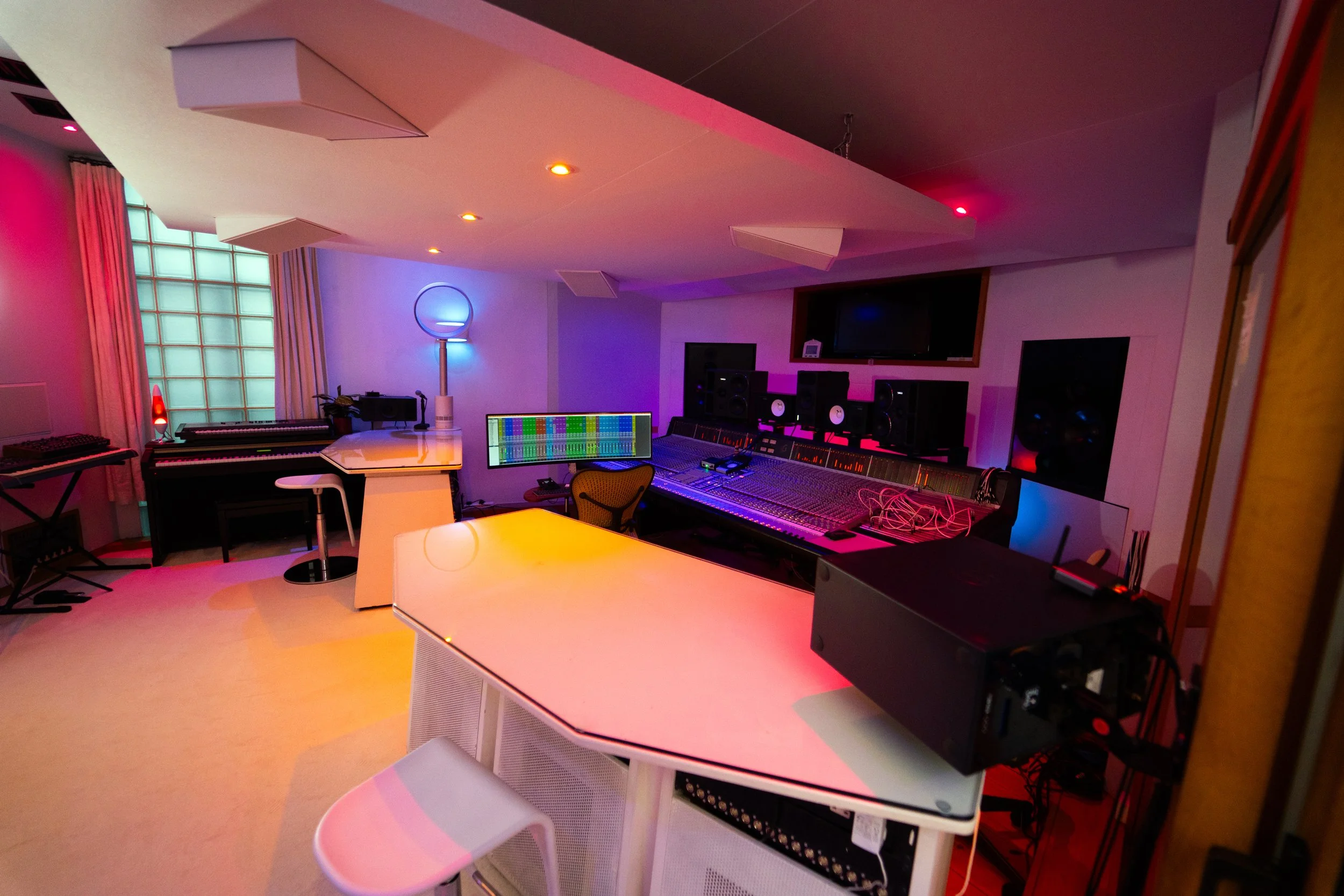
Centred around our customised SSL 4048 G Series console, Studio 1’s control room is designed for seamless collaboration, comfortably accommodating two engineers, dual producer workstations, and additional rear seating for artists and guests. The thoughtfully planned layout allows multiple creatives to work simultaneously, encouraging interaction while maintaining an efficient and focused workflow.
The producer’s workstation offers direct control over monitoring and talkback systems, while musicians in the live room can access Pro Tools and oversee sessions in real time—perfect for spontaneous punch-ins and fast-paced recording environments.
For mixing and production, the studio boasts an extensive collection of analogue outboard, revered classic processors, and the latest software tools, all supported by a comprehensive patching infrastructure incorporating MIDI, video sync, ethernet, cue distribution, and loudspeaker routing.
Positioned just feet from the producer’s table, the vocal booth enables close creative communication while maintaining complete acoustic isolation, ensuring performances are captured with both precision and comfort.
-
Westpoint's 28-foot live room has an impressive five square metre view from the engineer's chair.
Stacked with guitar amps and drum kits, the live rooms boast a rest area, smart TV and air conditioning, giving artists comfort, creative options and stress-free interaction with the engineer. For further speed, our live room is permanently set up with Quested v3110 mid-field monitoring, so artists can listen to previous takes and monitor mix down while relaxing to film or set up a second producer room. With its natural finish, wooden floors and high ceilings, our live room also provides the perfect ambient recording space for live bands, strings, brass, drums, vocals and piano.
-
4.5 by 3 meters, Westpoint’s vocal booth offers an ideal interactive space for producers and engineers to collaborate closely with artists. The floor-to-ceiling glass sliding door creates a bright, open feel and makes the booth perfect for content creation during sessions — live streaming, video capture, or behind-the-scenes footage — without compromising acoustics. Designed for comfort and workflow, the booth accommodates focused tracking while keeping visual connection to the control room, ensuring seamless communication and efficient session flow.
-
Between the control room and live room we also have a 14-foot strip with a 5 metre square view of the live room and control room for musicians requiring separation with a good line of sight, or a secondary guitar booth with ample patching options.
-
Our dedicated 4.5 metre cubed guitar booth is accessed from the live room and is flexible enough to play from any room in our facility. Should you want to do overdubs from the control room or record alongside other musicians in the live room with complete separation while changing settings on the head of your stack, our guitar booth will cover you.